▲Scientifically designed to help you keep running. Through repetition, not performance.
Six real voices to keep you company while you run. Over your own music, at your own pace.
iPhone · iOS 16+ · Free to download. Three full sessions, then a one-time unlock. No subscription.
Without a watch it works fully. With a watch, the coach knows more.
Run with your eyes up, not on a wrist.
Coached Run works alongside your watch and your favourite running app. Your watch captures the run, your app keeps its history, and Coached Run adds the voice on top. It also keeps a history of every session you ran with it, so your record lives on both sides.
The coach calls the session over your own music: when a block starts, when to ease, how you're moving through it. Between cues, silence. So the run stays yours.
The runs you enjoy are the runs you repeat. That's how the habit takes hold: not through discipline, through the feeling. Coached Run is built for the feeling.
Headphones in. Phone in your pocket. You run. The coach tells you the rest. And when the run feels good, you go out again tomorrow.
Run your way.
Not for a race. Not for a number. Not to add one more thing to your day.
Run because it clears your head. Because you feel better when you do. Because the door was hard and you already opened it.
Coached Run exists so it stays that way. A habit you keep because you want to.
The coach reads your body.
Pair any Bluetooth heart-rate monitor (Garmin, Polar, Coospo, chest strap) or an Apple Watch. The coach then reads your heart rate live, and uses it. You never see it. No zones, no graphs, no percentages, no heart rate number on screen. Just a heart beating below the clock, in real time, to yours.
♥︎
Coach on your wrist
Reads your heart rate, cadence and recovery live. Nudges you when the pace is too hard, when your stride goes long, when you're not recovering. Cheers you when your heart rate drops fast, when the stride finds its rhythm, when you sustain the same effort. Eleven live moments. Nearly half of them, a well done.
〰
Wrist taps on every change
Loud music or a noisy treadmill can swallow the voice. A tap on the wrist doesn't. One pattern entering intervals, another leaving them.
◎
Counts in your rings
Heart rate and calories logged in Health, filling your activity rings like any other run.
Any device is optional. Without one, the app works fully. With a Bluetooth heart-rate monitor the coach sees your effort. With Apple Watch it also taps your wrist and guides your stride.
Category-first move
No pace on your screen.
Every other running app puts the pace front and center. We took it out. It is still measured, still saved. It is just not shown while you run, because seeing the number is the fastest way to start running against it.
"The data is for the coach to use, not for you to watch."
Six things we believe about running
Hover any card to read why. This is the filter every part of the app is designed against.
01
Run to enjoy it.
Not to compete. Not against strangers, not against your own times from last Tuesday.
02
Run to stay in shape.
You don't need a race on the calendar to lace up. Fitness is a byproduct of showing up.
03
Run for your health.
Not to win. Your body cares about consistency, breathing and sleep. None of it comes from a stopwatch.
04
Run to escape.
A place to leave the day behind. Not another task on the checklist, not another notification demanding you.
05
Run because you want to.
Adherence isn't discipline. It's pleasure. The runs you keep are the ones you enjoyed.
06
Run by feel.
Your breath already tells you what your body is doing. You don't need a wrist to translate it.
For those who thought they'd never enjoy this again.
If you're coming back from an injury, from a long break, or from a stretch where running just stopped being fun, this app was built with you in mind too.
Coming back doesn't mean starting over. It doesn't mean chasing the times you used to hit, or the plan you used to follow. It means walking out the door and letting a coach walk with you at whatever pace your body has today.
"Running again doesn't have to look like it did before. It just has to feel worth doing tomorrow."
No goal. No calendar. No comparison. Just a voice that reminds you what you already knew: it's easier when someone's with you.
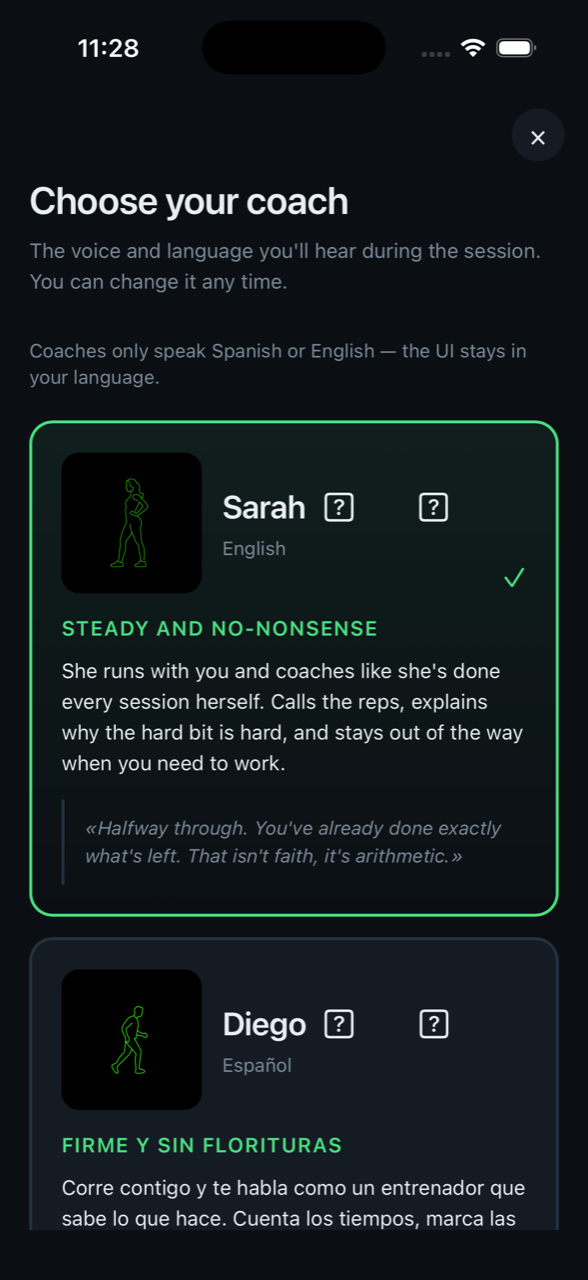
Six voices. Pick who runs with you.
Real accents, real personalities. Pick your coach for each session.
Not sure who to pick?
New to running→Luis · Iris
Less talk, more focus→Diego · Mike
A voice that keeps you going→María · Sarah
Included
Sarah
🇬🇧 English
Warm and precise. Runs like a friend who has been at it a while.
Steady and grounded. Reminds you nothing needs to feel extra today.
"Steady effort. That's the one. Nothing to prove."
Free download
Iris
🇺🇸 Beginners
Encouraging and calm. For starting again, or starting for the first time.
"You made it out the door. That was the hardest part."
Included
Diego
🇪🇸 Spanish
Melodic and technical. Gives the right cue at the right moment.
"The first interval always fools you. Save something for later."
Free download
María
🇪🇸 Spanish
Close and clear. Speaks as if she were right there beside you.
"Your pace today is this one. That's enough."
Free download
Luis
🇪🇸 Beginners
Patient and instructive. For beginners or for those coming back.
"You don't need to run fast. Just to run."
Sarah and Diego come with the app. Mike, Iris, María and Luis are a free in-app download, about 35 MB each.
Rewards for showing up.
Weekly goal, streak and achievements. Everything the app celebrates is about going out. Never about performance.
🎯
Weekly goal
Set the minutes you want to run this week. The app counts them. Anything under five minutes does not count, so three one-minute runs will not fool your streak.
🔥
Streak
Consecutive weeks you hit your own goal. Not against anyone else. Just against last week.
⭐
Achievements
Landmarks for showing up: first run, ten runs, first month in a row. Never for beating anyone or the clock.
The reward is for opening the door. Not for what you did once you were out.
Fitness test
Twelve minutes to know if you're improving. Without running fast, ever.
Every eight weeks or so, on your own, from the profile. Same twelve minutes as the Cooper test. Opposite philosophy. Your body responds, the app writes it down, and you can compare across tests. The first time, the coach explains the protocol before you start and reads each number back in voice when you finish.
3'
Walking
Warm up on foot. Nothing more.
6'
Very easy jog
Talk-test easy. Your body finds its natural rhythm.
3'
Recovery
Walk back. The app watches how fast your heart rate settles.
Three numbers you can compare test to test: the heart rate at a comfortable jog, how much it drops when you stop, and how steady it stayed. If your heart works less for the same effort and recovers faster, you're improving. No fastest anything required.
See it in action
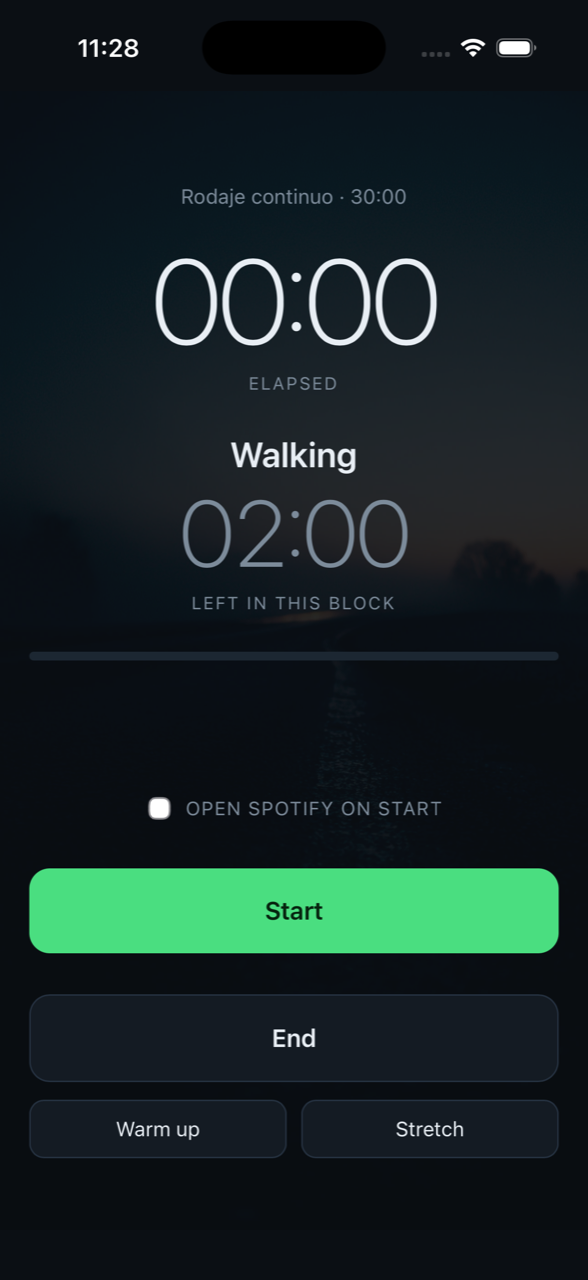
Minimal on the screen. Everything on the ear.
Onboarding
Pick your session
Choose your coach
Running
How it works
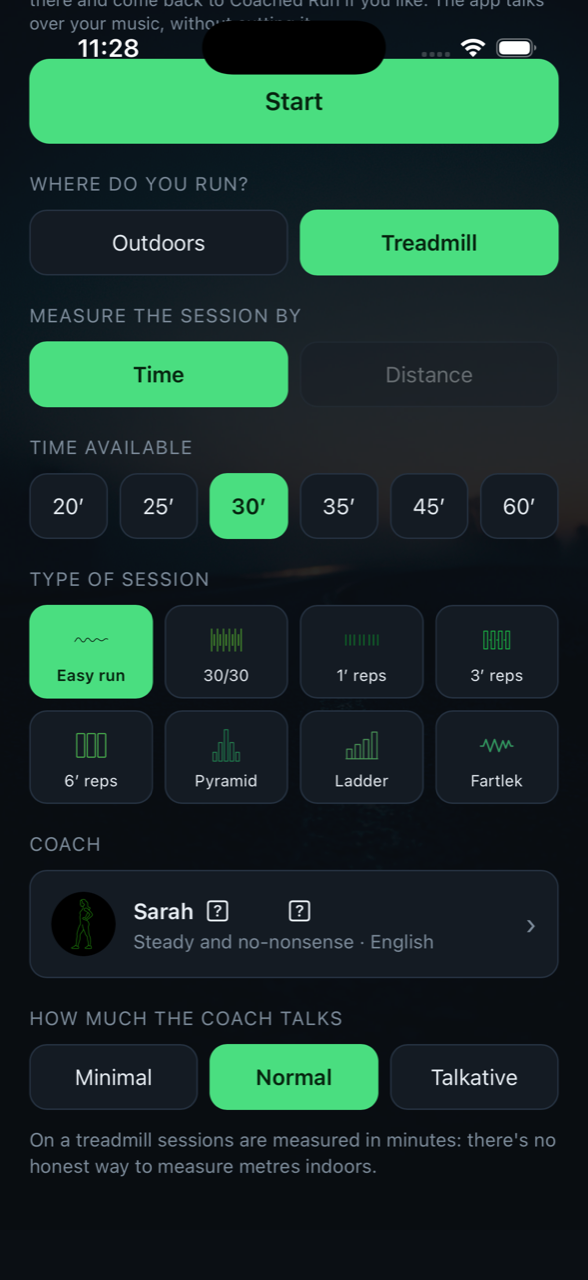
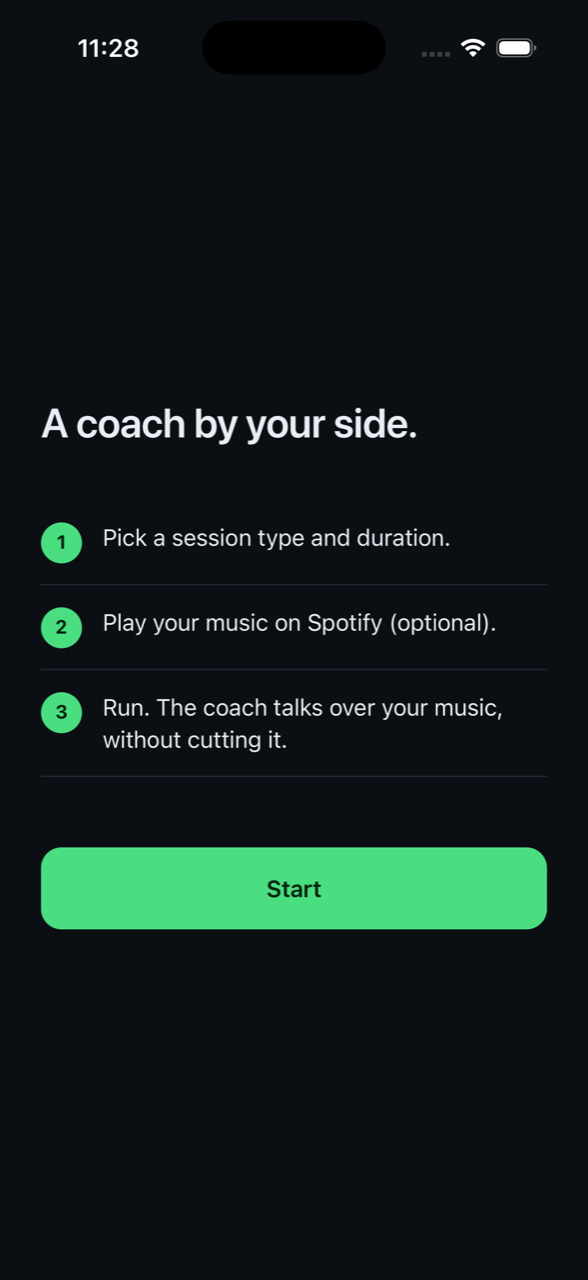
Three taps and the coach is with you.
Pick the shapeEight session types: easy run, 30/30, short intervals, medium intervals, long intervals, pyramid, ladder, fartlek.
Set the lengthBy time (20, 25, 30, 35, 45 or 60 minutes) or by distance: 3K, 5K, 10K, 15K, or the half marathon (13.1 miles). Km or miles: all six coaches speak in the unit you pick.
Outdoors or treadmillOutdoors uses GPS for splits and a halfway turnaround. Treadmill uses clean time-based intervals. Same coach, same session.
Choose your coachSix coaches: three in Spanish, three in English. Each speaks one language. The free version gives you the one for your language; with full access, switch whenever you like and your choice sticks for next time.
Optional: your musicSpotify, Apple Music, Podcasts, or silence. The coach speaks over whatever you're already playing.
RunPhone in your pocket. The coach cues the moments that matter and stays quiet the rest. Pause or skip a block if something interrupts you; the skipped time does not count as run. Incoming calls auto-pause the session. Rings, heart rate and calories logged like any other run when a device is paired.
Built on the science of adherence and enjoyment.
The most robust question in exercise science isn't about performance. It's about what keeps people running at all, over months and years. Coached Run is designed around that answer. Four decades of research point the same way.
Finding 01
You already have the best sensor for effort. It's your breath.
The Talk Test (can you speak a full sentence?) is clinically validated against ventilatory and lactate thresholds, and endorsed by the American College of Sports Medicine as a practical way to gauge exercise intensity.
Enjoyment is the strongest predictor of who keeps running.
Ekkekakis's integrated model of exercise adherence: the affective response to a workout predicts whether you come back. Discipline and appearance-based motivation don't. The runs you enjoyed are the ones you'll repeat.
Setting your own pace beats being told what pace to run.
Self-selected intensity produces more pleasure and better adherence than prescribed intensity, even when both end up at the same pace. The autonomy is what matters.
Watching your metrics too closely makes running harder to keep doing.
"Data anxiety" is a documented phenomenon. The more runners depend on constant feedback from wearables, the more the activity loses its spontaneity, and in some cases its joy.
Between 40% and 70% of new runners quit within six months.
The dropout curve on fitness apps and beginner programs is remarkably consistent. It's a design problem, not a willpower one. Coached Run is designed to sit on the other side of that curve.
Three sessions a week meet the WHO recommendation.
WHO recommends 150 to 300 minutes of moderate activity per week, and running is classed as vigorous, which counts double. Three sessions a week with this app put you inside that range. No fastest anything required.
One-time payment · no monthly fee · $12.99 from 2027. US price: the App Store shows yours.
+All six coaches, in Spanish and English
+Unlimited runs, for good
+The fitness test and your progress
+Everything that comes next, included
No subscription. No account. No ads. Pay once and that is it.
Common questions
Do I need an Apple Watch?
No. The app works the same without it. The watch adds wrist taps, live heart rate feedback, and logs the session in Health.
Will it tell me what pace to run?
No, on purpose. It tells you if you're going too hard for what the session calls for. It never tells you what speed to go at.
Does it work with Spotify?
Yes. Apple Music and Podcasts too. The music ducks when the coach speaks and comes back after. Silence works also.
Where can I download it?
Everywhere. Spain and the rest of the EU cleared on 4 September 2026, joining the US, UK, Switzerland, LatAm and the rest of the world. Worldwide, and now free to start.
Is the fitness test an all-out effort?
No. You never run fast. It measures how your body responds to a comfortable jog, not how far you can push.
Do I need an Apple Watch to use the coach live?
No. Any Bluetooth heart-rate monitor works: a chest strap costs around thirty euros and needs no setup, it broadcasts the moment you put it on. Apple Watch adds cadence coaching, wrist taps and rings.
Available worldwide. Spain and the 26 other EU countries joined on 4 September 2026, alongside the US, UK, Switzerland, LatAm and the rest of the world.
A fitness number that tells you what it does not know.
Every other app hides how it calculated your score. Ours says it out loud: on how many components, and what changes when you add a sensor.
No device
Volume
Regularity
Perceived effort
Variety
+ Heart-rate monitor
Volume
Regularity
Perceived effort
Variety
+ Heart-rate recovery
+ Aerobic efficiency
+ Apple Watch
Volume
Regularity
Perceived effort
Variety
Heart-rate recovery
Aerobic efficiency
+ VO2 max
+ Resting heart rate
"
Adding a sensor can bring your number down. That does not mean you got worse. It means it was measured on less before. The screen always tells you how many components it was calculated on.
How you recover
The line that goes up without running any faster.
When a session ends, the app watches one thing: how far your heart rate falls in the minute after you stop. Week by week that draws a line. It rises as your fitness rises, and it owes nothing to your pace.
Example. Beats your heart rate drops in the first minute after finishing, week by week.
Any monitor will do
Apple Watch, or any Bluetooth heart-rate monitor: chest strap, armband, sports watch. The measurement is the same.
Nothing to do
No test, no button. It comes out of the session you just ran, every time you go out with a monitor on.
The opposite of a personal best
A record rewards one good day. This rewards the weeks underneath it. You can improve here on a slow, easy run.
"
It is the most reliable fitness signal the app can measure. It rises with training, and it does not depend on how fast you run.
It doesn't measure how fast you go. It measures whether you'll come back tomorrow.
Ready when you are.
iPhone · iOS 16+ · Free to download. Three full sessions, then a one-time unlock. No subscription.